
What Helps a Family Business Last?
A successful family business is about more than revenue, growth or a strong balance sheet.
It is also about whether family members can make decisions together, whether the next generation is being prepared, and whether difficult conversations can take place before they become damaging conflicts.
Many family enterprises are built on commitment, hard work and a founder’s vision. Yet, as the family and business grow more complex, the informal ways of making decisions that worked in the early years can begin to come under pressure.
Questions that once seemed distant can become urgent:
– Who will lead the business in the future?
– How will ownership be shared or transferred?
– What role should family members play in the business?
– How will the family make decisions when views differ?
– What do we want the business, wealth and family legacy to make possible?
There are no universal answers. Every family is different. However, families that endure tend to create the time and structure needed to address these questions thoughtfully.
Start with purpose
A long-lasting family business needs more than an agreed commercial strategy. It needs a shared understanding of purpose.
Why does the family want to remain connected to the business? What values should guide important decisions? What does success mean beyond financial performance?
When a family has not explored these questions, decisions about ownership, investment, leadership or succession can easily become personal. When there is shared purpose, those same decisions can be considered against a clearer set of principles.
Make room for the conversations that matter
The conversations that most need to happen are often the ones that are postponed.
A founder may find it difficult to talk about stepping back. Adult children may be uncertain whether they are genuinely wanted in the business. Siblings may avoid discussing differences in contribution, ownership or future expectations because they fear creating conflict.
Avoidance can feel easier in the short term. But unresolved assumptions often do not disappear; they become embedded and can later emerge as frustration, mistrust or conflict.
Constructive conversations do not require a family to agree on everything. They require a way to listen, clarify expectations and make decisions that people understand, even when they are not everyone’s first preference.
Create governance that fits the family
Governance is sometimes seen as formal or bureaucratic. In practice, good governance gives a family a reliable way to communicate and decide.
This might include:
– A family charter setting out shared values, expectations and principles.
– A family council where family members can discuss issues separate from day-to-day business management.
– Clear roles for owners, directors, executives and family members.
– A succession process that prepares both the outgoing and incoming generations.
– Appropriate oversight of family investments and advisers, aligned with the family’s purpose.
The structure should fit the family. The point is not to adopt a template, but to create agreements and decision-making processes that will be respected when pressure arises.
Treat succession as a process
Succession is not a single announcement or legal transaction. It is a transition of leadership, ownership, responsibility and identity.
For founders, this can involve complex questions about timing, trust and their future role. For the next generation, it may involve developing confidence, capability and legitimacy. For the wider family, it can raise questions about fairness, opportunity and the balance between family relationships and commercial requirements.
The earlier these matters are addressed, the more choices a family has. A thoughtful transition gives people time to prepare, test arrangements and adapt together.
Building a business that lasts
No family business can avoid every challenge. But families can reduce unnecessary conflict and improve their ability to respond to change.
The foundations are often straightforward:
– Shared purpose.
– Clear expectations.
– Constructive communication.
– Appropriate governance.
– Deliberate preparation for the next generation.
At Family Business Central, we work with families to build these foundations in ways that reflect their particular history, values and ambitions.
Join us in Wellington
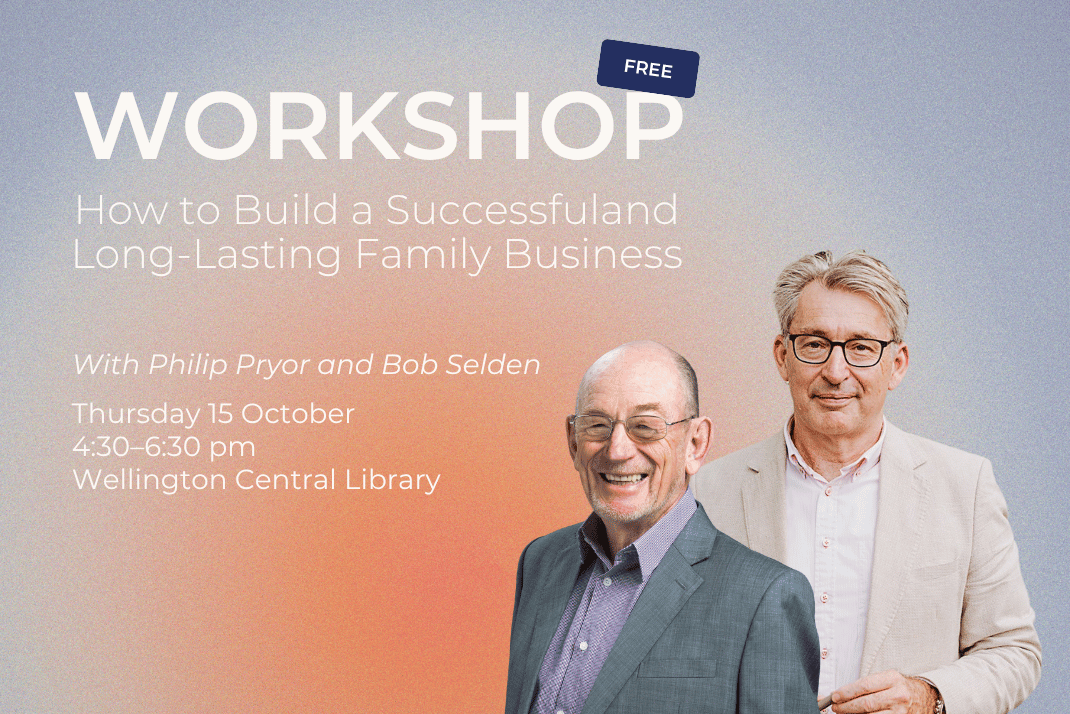
On Thursday 15 October, Philip Pryor and Bob Selden will lead a free workshop at Wellington Central Library: “How to Build a Successful and Long-Lasting Family Business“.
The workshop is for family-business members who want to explore the practical steps that support continuity, stronger relationships and sound decision-making across generations.